TIL has never stood still. From the process-heavy world of ITIL v2 and ITIL v3 to the more flexible, value-focused approach introduced with ITIL 4, each evolution has reflected changes in how organisations use and manage technology.
Now we have the next step: ITIL (Version 5).
And this time, the environment around ITIL has changed considerably. Cloud services are everywhere. AI is rapidly becoming part of everyday operations. Product and service management are increasingly intertwined. Digital experience matters just as much as technical performance.
So, is ITIL 5 a complete replacement for ITIL 4?
Not really.
A better way to describe it is evolution rather than revolution. ITIL 5 retains important concepts from ITIL 4, including the Value System, Guiding Principles, Four Dimensions, practices and continual improvement, while extending the framework to address the realities of modern digital organisations.
1. From Service Management to Product and Service Management
Perhaps one of the most important changes is visible in the language itself.
ITIL is no longer positioning itself purely around service management. ITIL 5 brings digital product and service management much closer together.
That distinction matters.
Many organisations no longer have a clean separation between “the product” and “the service”. A digital banking platform, SaaS application or customer portal is simultaneously a product being developed and a service being consumed.
Development teams might think in terms of products, releases and features, while service management teams think in terms of services, incidents, changes and support.
From the customer’s perspective, however, it is one experience.
ITIL 5 recognises this and provides end-to-end guidance intended to connect the two worlds more effectively.
2. A New Product and Service Lifecycle Model
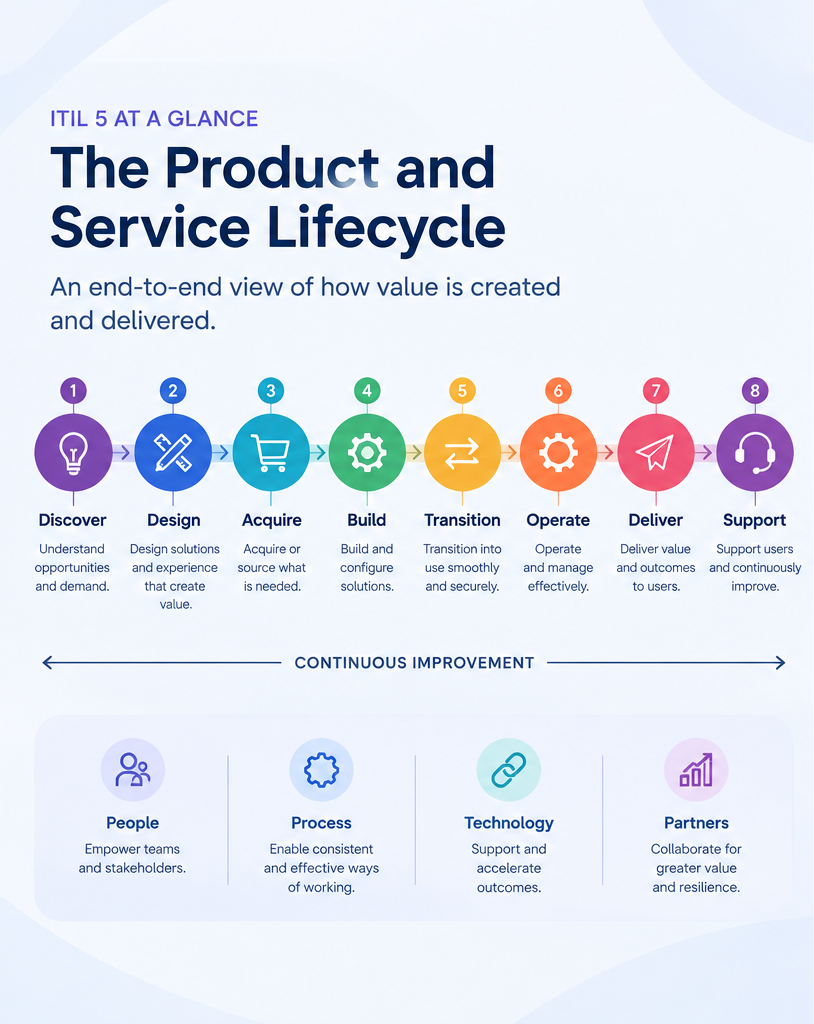
One of the most visible additions is the eight-stage Product and Service Lifecycle Model.
The stages are:
Discover -> Design -> Acquire -> Build -> Transition -> Operate -> Deliver -> Support
This gives organisations a more recognisable end-to-end view of how digital products and services move from an idea or opportunity into something that is built, operated, consumed and supported.
Importantly, this does not mean ITIL has simply returned to a rigid lifecycle model.
The intention is to provide a practical structure while retaining the adaptability introduced through ITIL 4. The lifecycle activities can interact, overlap and operate within complex digital ecosystems rather than functioning as isolated silos.
For practitioners, this may make ITIL considerably easier to connect to the reality of product development, DevOps, operations and service management.
3. ITIL Is Becoming AI-Native
It would be difficult to release a major technology management framework in 2026 without addressing AI.
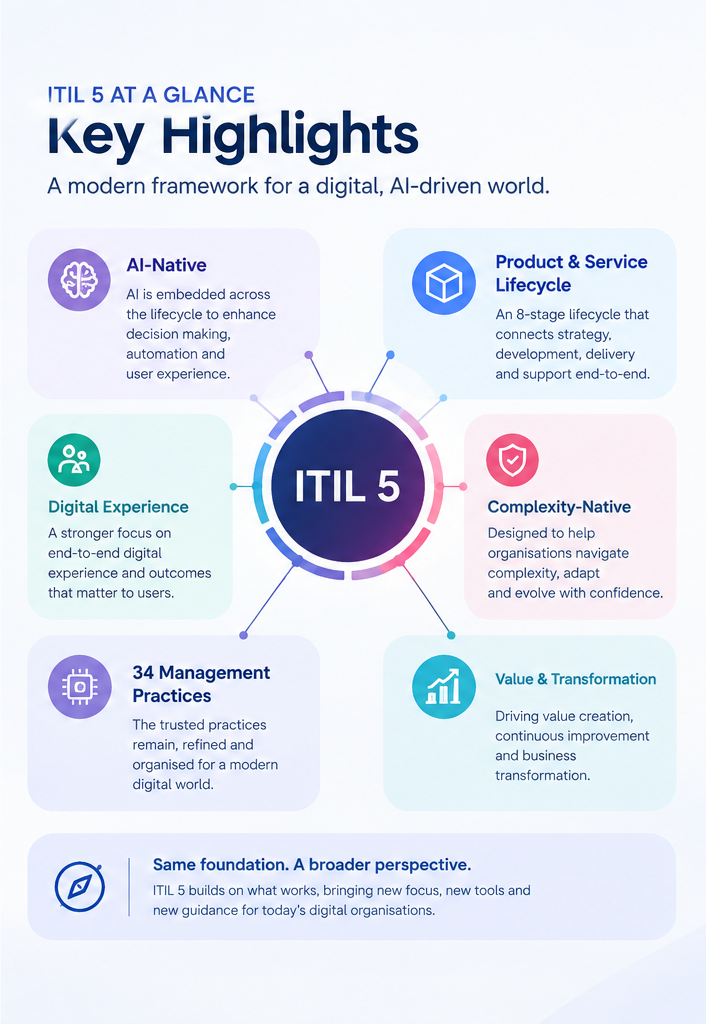
ITIL 5 goes further than simply adding a chapter about artificial intelligence. It describes itself as AI-native, recognising that AI is increasingly becoming part of how digital products and services are designed, delivered, supported and improved.
That has practical implications across ITSM.
AI can support activities such as:
- Incident classification and routing
- Knowledge discovery
- Service desk assistance
- Trend and pattern identification
- Predictive analysis
- Workflow automation
- Decision support
- User experience analysis
- Continual improvement
But adopting AI is only half of the challenge.
Organisations also need to think about governance, accountability, transparency, risk and ethical use.
This is reflected particularly clearly in the new ITIL AI Governance (Version 5) extension module, which focuses on helping organisations adopt and scale AI while maintaining appropriate oversight and control.
The message is important: using AI effectively is not simply an automation challenge. It is also a governance challenge.
4. Digital Experience Gets a Much Bigger Seat at the Table
This is another development I find particularly relevant to modern service management.
For years, organisations have measured IT performance through traditional operational metrics:
“Was the system available?”
“Did we respond within the SLA?”
“How quickly was the incident resolved?”
All useful questions.
But they don’t necessarily answer another important one:
Did the user actually have a good experience?
ITIL 5 puts much greater emphasis on digital experience, recognising that technically successful services can still create poor outcomes for users.
This connects naturally with the growing interest in experience management and XLAs.
A service might achieve 99.9% availability and meet every response target while users continue to struggle with poor performance, complicated processes or frustrating interactions.
ITIL 5’s stronger focus on experience encourages organisations to look beyond whether technology technically works and consider how effectively people can use it to achieve the outcomes they need.
5. ITIL Is Designed for Complexity, Not Just Predictability
Traditional management models often assume that we can understand a situation, create a plan and execute it.
Modern digital environments are rarely that simple.
Cloud ecosystems, AI, third-party services, distributed architectures, changing customer expectations and rapidly evolving technologies create environments where organisations cannot always predict what happens next.
ITIL 5 therefore describes itself not only as AI-native but also as complexity-native.
This means recognising that experimentation, feedback and adaptation may sometimes be more appropriate than attempting to design the perfect process in advance.
For organisations that already combine ITIL with Agile, Lean and DevOps, this should feel like a natural progression rather than a contradiction.
6. The 34 Management Practices Remain
Anyone worried about having to throw away their existing ITIL knowledge can relax.
The 34 ITIL management practices remain, although they are being adjusted to align with the new framework.
They are now organised into two broad groups:
Product and Service Management Practices
and
General Management Practices
The important point is continuity.
Incident Management is still Incident Management. Problem Management, Service Level Management, Service Configuration Management, Change Enablement and Continual Improvement have not suddenly disappeared.
Instead, ITIL 5 changes the wider context in which those practices operate.
This is particularly important for organisations that have already invested heavily in adopting ITIL 4. Moving towards ITIL 5 should not mean redesigning everything simply because a new version has appeared.
7. More Practical Guidance
One criticism occasionally directed at ITIL 4 was that some concepts could feel abstract, particularly at Foundation level.
The Service Value System, Value Chain, Four Dimensions and Guiding Principles were powerful concepts, but practitioners still had to answer a very practical question:
What does this actually mean when I go back to work on Monday?
ITIL 5 attempts to close some of that gap.
Foundation now introduces more practical terminology from management practices and provides clearer explanations of how concepts are applied. Some material previously encountered primarily in advanced ITIL 4 modules is also introduced earlier.
This is an important direction.
A framework becomes valuable when people can apply it, not simply when they can pass an exam about it.
8. A Revised Qualification Structure
The certification structure is evolving too.
ITIL Foundation remains the entry point, while the higher-level scheme is organised around three major streams:
- ITIL Practice Manager
- ITIL Managing Professional
- ITIL Strategic Leader
Achieving all three designations leads to ITIL Master, which remains the highest ITIL designation.
The Managing Professional route now includes modules covering Product, Service, Experience and Transformation, reflecting the broader direction of the framework.
There are also transition options for existing ITIL professionals, including a Foundation Bridge and Managing Professional Transition route.
Importantly, existing ITIL 4 knowledge has not suddenly become obsolete. ITIL 5 deliberately builds on it, and ITIL 4 certifications can still support progression into the new qualification structure.
So, What Does ITIL 5 Really Change?
Perhaps the biggest change is not an individual practice, diagram or certification.
It is the scope of the conversation.
ITIL once helped organisations manage IT infrastructure.
It evolved into a framework for managing IT services.
ITIL 4 moved the conversation towards value co-creation, flexibility and integrated ways of working.
ITIL 5 takes another step and asks organisations to think about digital products and services, AI, experience, complexity, governance and transformation as interconnected parts of the same environment.
That reflects how technology actually works in modern organisations.
The boundaries between development and operations, products and services, IT and business, automation and human decision-making are becoming increasingly difficult to draw.
ITIL is adapting to that reality.
Don’t Throw Away Your ITIL 4 Playbook
There is always a temptation when a new framework version appears to start renaming things, rewriting processes and launching a “transformation programme”.
That would miss the point.
If your Incident Management practice works, keep it.
If your Service Level Management approach creates value, keep improving it.
If your Change Enablement process balances speed and risk effectively, don’t redesign it simply because ITIL has a new number.
Instead, ITIL 5 gives us a useful opportunity to ask better questions.
Are our product and service teams genuinely working together?
Are we using AI responsibly rather than simply using AI because everyone else is?
Are we measuring user experience as well as operational performance?
Can our governance cope with complexity and rapid change?
And most importantly:
Are our digital products and services actually creating the value they were designed to create?
That is where the real value of ITIL 5 will be found.
At Northera IT Solutions, we help organisations turn frameworks such as ITIL into practical operating models rather than collections of processes and documentation. From ITSM maturity assessments and process design to ITSM tool implementation, CMDB development and continual improvement, the objective remains the same: apply the guidance that creates value, adapt it to the organisation, and avoid unnecessary complexity.